A launch decision, not another dashboard
OutboundQA turns technical infrastructure evidence into a clear launch verdict and practical next actions.
Choose optional tracking
Essential storage keeps the site working. Analytics helps us improve it. Affiliate tracking credits the partner who referred you.
Affiliate resources
Use these product facts, proof links, and ready-to-adapt messages to explain OutboundQA accurately. Keep your own voice. Never promise inbox placement or guaranteed results.
Product facts
OutboundQA turns technical infrastructure evidence into a clear launch verdict and practical next actions.
It assesses the outbound assets around a launch without being the tool that sends, warms, or operates the campaign.
A report records the baseline, risks, fixes, and verified recovery so a client can understand the launch decision.
Do not describe OutboundQA as an email sender, a warmup service, or a placement guarantee.
Brand kit
Keep the logo proportions and colors intact. Do not place the wordmark on a surface with weak contrast.


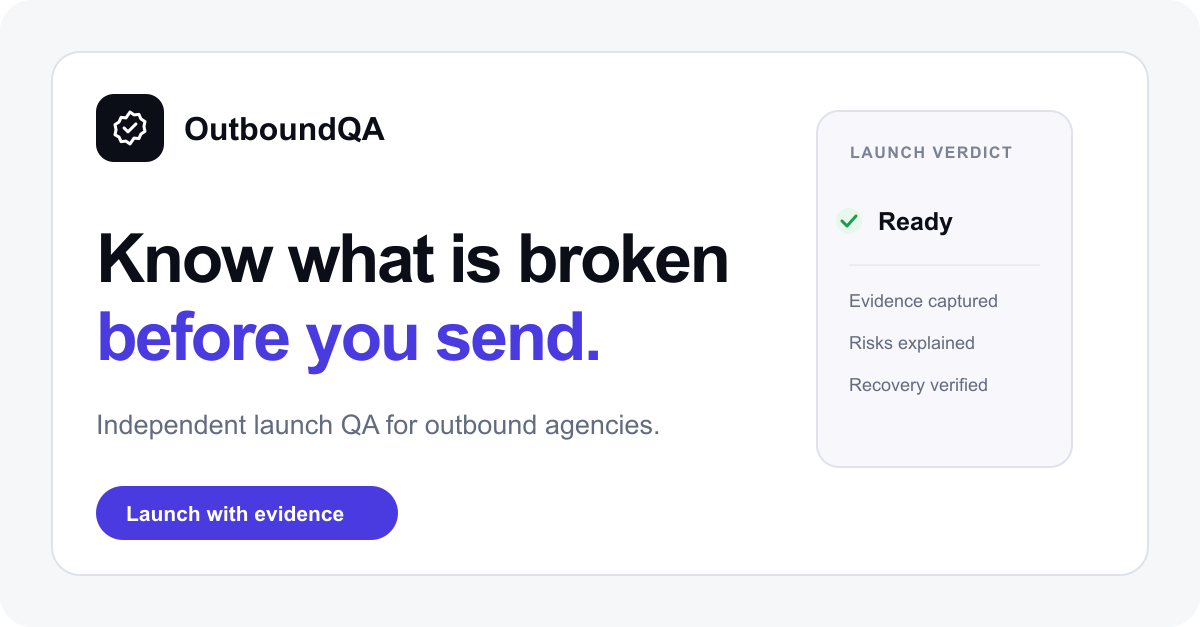
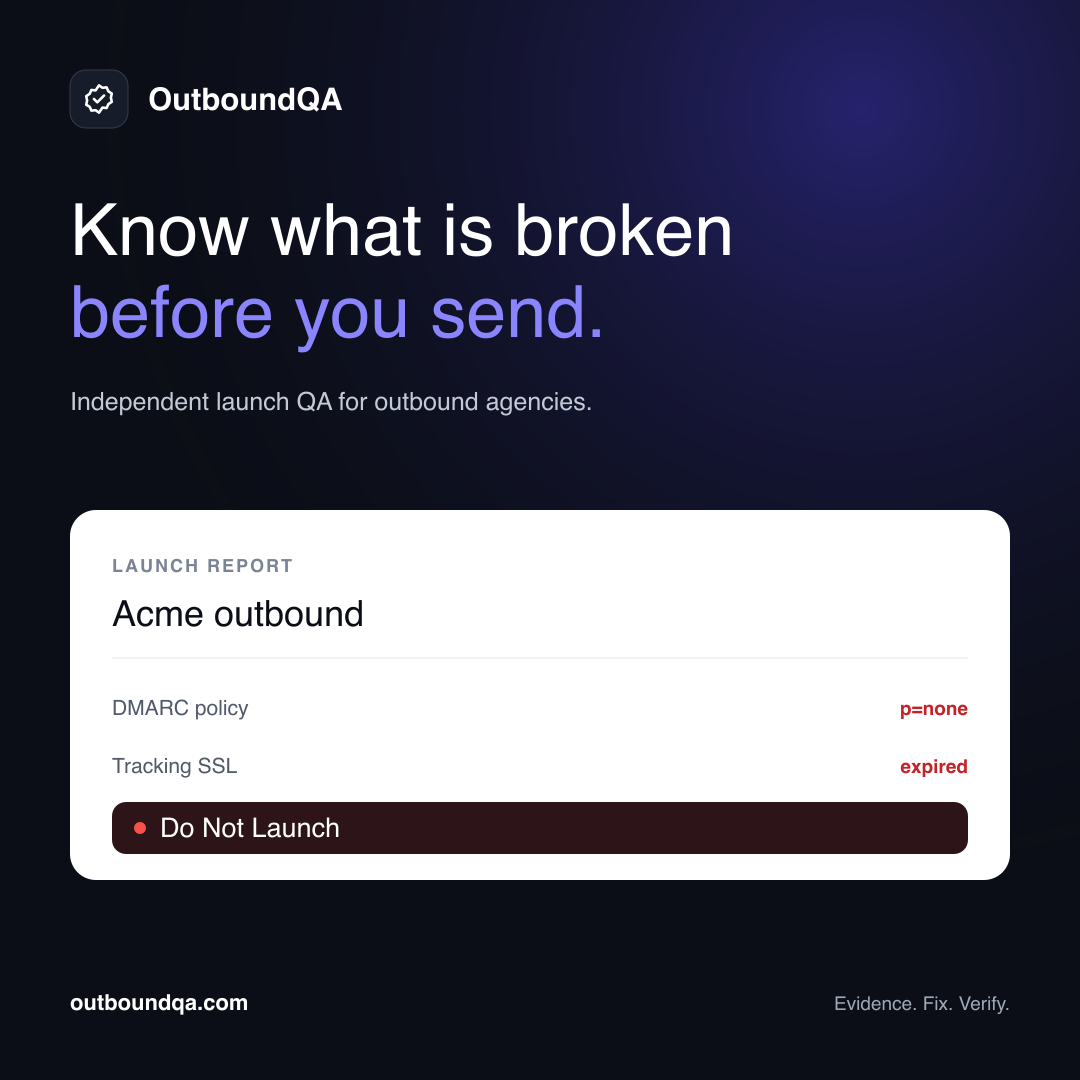
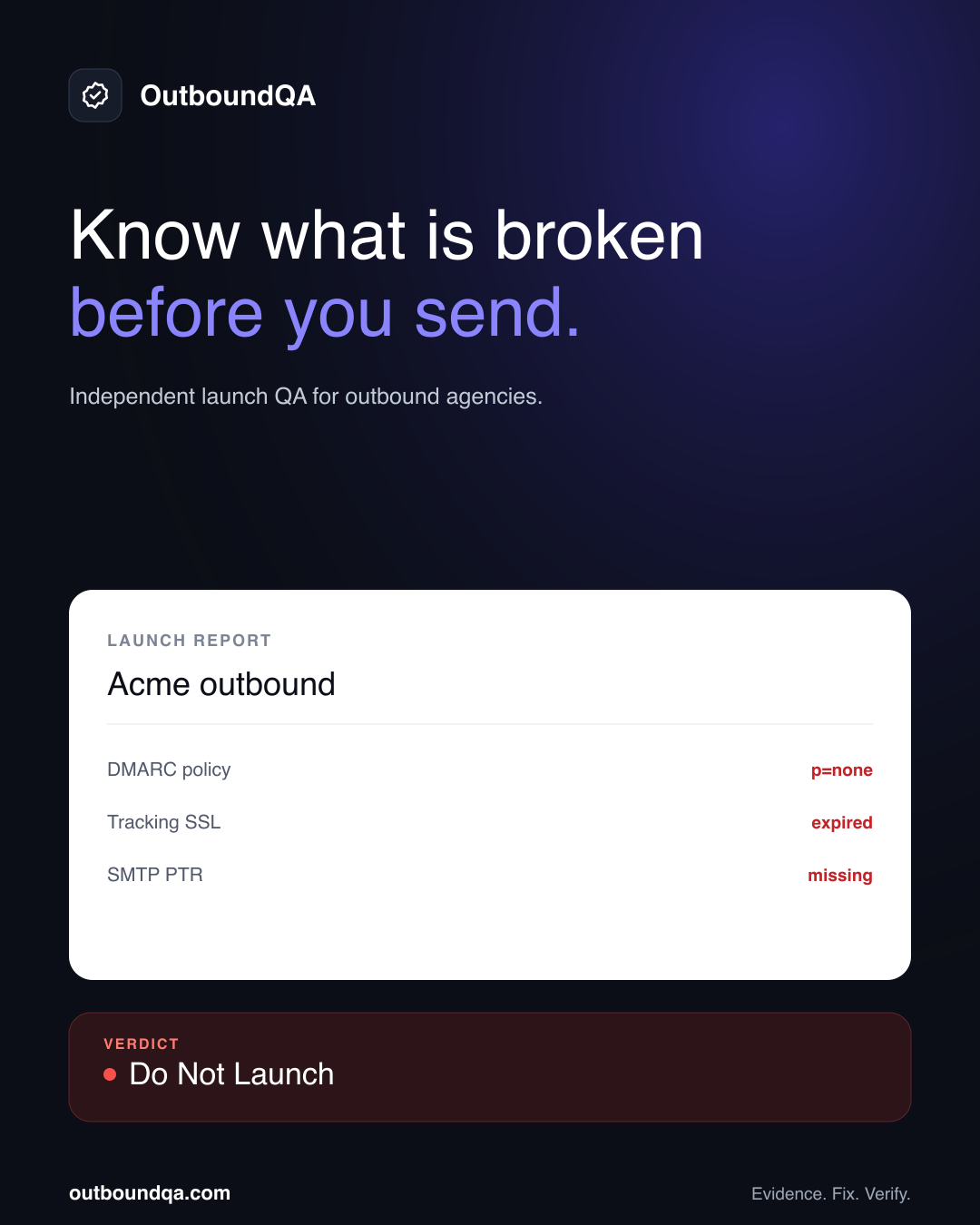



The three page deck with placeholders left in, ready to attach. Customise it at /affiliates/handoff-deck/.
Download assetMessages to adapt
These are starting points, not scripts. Add the context you have earned with your audience and only make claims you can substantiate.
For an agency client or consultant handoff
Before we approve this outbound setup, run an independent OutboundQA check. It identifies infrastructure blockers, explains the fix, and creates a launch verdict we can share. I may earn a commission if you purchase through my link.
For an operator group or newsletter
A sending tool can show that a campaign is configured, but it does not provide independent launch acceptance. OutboundQA checks the surrounding infrastructure and records the evidence behind the verdict. I may earn a commission if you purchase through my link.
For a deliverability or agency conversation
If replies drop, separate infrastructure evidence from copy and targeting assumptions. OutboundQA checks domains, inboxes, tracking, SMTP, and message evidence, then shows what is broken or uncertain. I may earn a commission if you purchase through my link.
For operators teaching client launch quality
A green sending dashboard is not a launch approval. OutboundQA checks the infrastructure around an outbound launch, gives a Ready, Needs Fix, or Do Not Launch verdict, and records verified recovery. I am an OutboundQA affiliate and may earn a commission from purchases through my link.
For a practical tool recommendation
Tool worth testing: OutboundQA provides independent cold email infrastructure QA before launch and continuous monitoring after it. The $49 Launch Report includes a 20-minute findings debrief. Disclosure: I may earn a commission if you purchase through my link.
For YouTube, Loom, or a course resource
OutboundQA checks outbound infrastructure and creates an evidence-backed launch verdict. It is not a sender, warmup tool, or placement guarantee. Affiliate disclosure: I may earn a commission if you purchase through this link.
LinkedIn posts
Copy a post, swap the bracketed details for your own, and publish. Each one is built to teach first and recommend second.
[client name], [industry], and the other brackets with a real detail.[your tracked link] at the free domain check, not the homepage, so a reader gets a real verdict.https://outboundqa.com/tools/ For agencies that sign off on a client's outbound launch
A new client asked me to approve their cold email launch. Here is what I do before I say yes. I do not trust a green sending dashboard. A sending tool can only confirm its own setup. It cannot grade the infrastructure around it. So I run an independent OutboundQA check on the sending domains, inboxes, tracking, and SMTP. It returns one verdict: Ready, Needs Fix, or Do Not Launch. Every finding comes with the evidence and the exact fix. For [client name] in [industry], that turned a vague "looks fine" into a launch decision I could defend. If you approve outbound setups for clients, run the check first: [your tracked link] Disclosure: I am an OutboundQA affiliate and may earn a commission if you purchase through my link.
Swap the hook
For a near-miss story about authentication
We were 30 minutes from launching a few thousand cold emails. The check came back Do Not Launch. The reason was DMARC. The record existed, but the policy did not meet what Gmail and Yahoo now require from anyone sending at volume. We paused. We fixed the record. We reran the check and watched it turn to Ready with the evidence attached. That is the whole point of an independent check. It catches the one thing that quietly holds up a launch before you send, not after replies go missing. Check your sending domain in seconds, no signup: [your tracked link] Disclosure: I may earn a commission if you purchase through this link.
Swap the hook
For the case that launch QA is a moment, not a guarantee
Everything passed on launch day. The problem showed up three weeks later. A change upstream quietly altered our DNS. Nobody touched the campaign. The infrastructure drifted anyway. Monitoring caught it and flagged the change against the approved baseline. We fixed it the same day instead of discovering it in a slow reply-rate drop a month later. Launch QA is a moment. Monitoring is the insurance. If you run outbound for clients, you want both. See how the baseline and verdict work: [your tracked link] Disclosure: I am an OutboundQA affiliate and may earn a commission if you purchase through my link.
Swap the hook
For teaching a specific, checkable failure
The SPF record looked correct. It was still a risk. SPF allows a maximum of 10 DNS lookups. Add a few sending tools and a couple of vendors, and you quietly cross that limit. Once you do, SPF can stop evaluating the way you expect. The record reads fine to the eye. A checker that counts the lookups tells you the truth. OutboundQA counts the lookups, ties them to a launch verdict, and shows the exact fix. No more "it looks fine." Count your lookups in seconds: [your tracked link] Disclosure: I may earn a commission if you purchase through this link.
Swap the hook
For reframing a blocker as the check doing its job
I got a Do Not Launch verdict and I was glad. A client wanted to send this week. The check found a blocker serious enough to hold the launch. Sending into it would have burned a domain we could not easily replace. Do Not Launch is not a failure. It is the check doing its job. We fixed the blocker, reran, and launched on evidence a few days later instead of on hope. A green dashboard tells you the tool is happy. An independent verdict tells you whether you are actually ready. Check a domain free: [your tracked link] Disclosure: I am an OutboundQA affiliate and may earn a commission if you purchase through my link.
Swap the hook
Proof to share
Send referred traffic here instead of the homepage. A prospect enters a real domain and gets a real MX, SPF, and DMARC verdict in seconds, with no signup.
Open free checkA three page pre-launch summary you fill in and forward: what was checked, the verdict this client received, and what launching with unresolved blockers costs. Editable in the browser, prints to PDF, and nothing you type is uploaded.
Open handoff deckShow the format a referred team receives: verdict, evidence, owner, and next action.
Open sample reportUse current plan details when a prospect asks what comes after their first launch decision.
Open pricingHonest objection handling
Promotion guardrails