Skip to content
EssentialSecurity, theme, and saved preferences.Always on

We do not send your name or email to affiliates.

Changelog

What is new in OutboundQA

Customer-facing improvements to launch checks, evidence, reports, monitoring, and the workflows around them.

Find an update by customer impact

Showing 10 updates

Production evidence for monitoring controls

Reports and evidence

Continuous QA now distinguishes configured controls from real delivery, receiver, provider, timing, and cost evidence.

Continuous QA now keeps an auditable record of the production evidence behind its monitoring controls.

See what has produced fresh evidence

The workspace dashboard shows monitoring assurance for:

  • The latest completed full check and configured cadence.
  • DNS assets with stored change-detection baselines.
  • Email, Slack, and signed webhook destinations tested successfully in the last seven days.
  • DMARC aggregate reports and receiver-reported message volume from the last seven days.
  • Conclusive blacklist results tied to a named provider.

A configured destination or provider is not presented as tested until it returns real evidence. If the assurance endpoint is unavailable, the dashboard says so without changing the existing verdict or incident history.

Measure alert and verification timing

Operators can persist evidence from three reversible DNS drift and recovery drills plus one reversible non-DNS regression drill. OutboundQA calculates p50 and p95 change-to-alert and change-to-verification time from complete production samples only.

Incomplete samples remain available for investigation and do not enter the timing distribution.

Keep hourly monitoring economically accountable

The production readiness gate now attributes configured blacklist, reputation, Safe Browsing, and per-asset infrastructure costs to recent scheduled canary runs. It projects cost for 100 assets across a month of hourly checks, adds the monthly account allocation, and compares that result with the $79 Continuous QA price and the configured gross-margin floor.

Refunds, taxes, and unallocated labor remain separate operating costs.

The release adds the evidence collection and fail-closed gates. It does not claim that production drills have passed until the required provider deliveries, RUA traffic, drift, recovery, and timing samples are recorded.

Launch Report debrief and lifecycle proof

Reports and evidence

The $49 Launch Report now includes a findings debrief, a recovery sample, and durable product milestone tracking.

Launch Report now includes a 20-minute findings debrief after the first verdict. The purchase email explains how to request it, and pricing now presents the debrief as part of the one-time $49 offer.

See the complete proof trail

The anonymized sample now shows four distinct moments:

  • The baseline asset inventory captured before launch.
  • The blocker discovered by the first full check.
  • The remediation action taken by the operator.
  • Recovery confirmed by a fresh verification run.

The sample is explicitly a composite using reserved names. It is not presented as a customer testimonial or an inbox-placement guarantee.

Measure the paid journey without inflated counts

OutboundQA now stores a durable, deduplicated ledger for Launch Report purchase, first verdict, remediation return, verified recovery, report sharing, and Continuous QA activation. Provider retries, worker retries, and repeated share clicks do not create extra lifecycle milestones.

These milestones contain product IDs and operational classifications, not customer domains, inbox addresses, DNS values, or public report tokens.

Smartlead and Instantly imports, Gmail Postmaster evidence, client portal roles, additional DNS providers, and faster agency cadence remain ordered discovery work. They are not presented as shipped features.

Agency-owned reports and reliable DNS drift alerts

Reports and evidence

Continuous QA can present shared reports under the agency's identity, record public-open activity, and keep each DNS change tied to one incident.

The client-facing proof and the monitoring incident now stay owned by the team responsible for the launch.

Present the report under your agency identity

Continuous QA account owners can add an agency logo in Account settings. Shared reports then use the agency name and logo in place of OutboundQA branding.

An agency-branded report does not include an OutboundQA sales call to action. The client sees the launch verdict, evidence, and remediation record without a competing promotion in the report wrapper.

This opt-in changes the shared-report identity. It does not add a custom domain, custom colors, or a native PDF export.

The signed-in report view now shows:

  • Total public opens.
  • The first public-open time.
  • The latest public-open time.

The count includes repeat requests and automated link previews. It is not a unique-person count and does not identify the viewer. This keeps the activity useful as delivery evidence without presenting it as individual client analytics.

Keep one DNS change tied to one incident

Continuous QA uses both the complete hourly check suite and a focused DNS sentinel. A watched record can be observed by either path first.

The two paths now share exact-once dispatch. A confirmed MX, nameserver, SPF, DMARC, DKIM, CAA, root-resolution, or tracking-CNAME change is recorded once. Actionable drift is attached to one active incident and verified by a fresh full run.

DMARC paging follows the meaning of the change. Deletion, new invalid policy data, test mode, or weaker enforcement is critical. A strengthening change is retained in history without paging unless another check regresses.

A transient lookup error remains unknown. It does not replace the known baseline or create a false recovery.

Affiliate program foundation

Partners

OutboundQA now has consent-aware affiliate attribution, exact program terms, and a complete public starter kit.

OutboundQA now has a public affiliate program page for outbound consultants, agency operators, educators, communities, and creators who refer teams that need a defensible pre-launch decision.

What the program page explains

  • Approved partners earn 30% commission on eligible customer payments.
  • The partner dashboard is the source for referral, eligibility, and payout status.
  • Affonso credits the last eligible affiliate click before signup. OutboundQA locks that referral to the account at account creation and carries the same stable user ID into a trusted checkout session.
  • The application flow, partner fit, and ineligible referral types are shown before a visitor applies, so the page is easier to scan and attracts more relevant partners.

The public website and product use one versioned consent preference with separate Analytics and Affiliate controls. Optional tracking starts off. A visitor can accept all, reject optional tracking, manage each choice, or return to Cookie preferences later. Referral context can cross the website and app before a choice, then stops after explicit rejection.

Email and Google registrations now pass the same sanitized attribution. With Affiliate consent, each successful new registration uses Affonso’s documented browser signup API to record one lead. Existing-user sign-ins do not create a lead. Dodo receives the locked referral in checkout metadata and remains responsible for purchase, renewal, refund, and cancellation events, so revenue is never reported twice.

The join actions open the hosted Affonso portal from validated public build configuration. Placeholder IDs and an unapproved portal host fail validation. The generated website now preserves the pixel’s program and consent attributes, so referral visits create the cross-domain tracking ID instead of loading an unconfigured provider module.

Resources for partners who are ready to share

The new affiliate resources page provides product facts, proof links, channel-specific starting points, clear disclosures, objection handling, and promotion guardrails. It gives approved partners useful material without inventing social proof, earnings estimates, or deliverability guarantees.

The affiliate program now also has dedicated program terms, a hosted Affonso signup handoff, downloadable light and dark logo variants, a standalone mark, and landscape, square, and portrait social cards. SVG and PNG variants are available, and a generated starter kit bundles them for download. Affiliate resources are now the secondary action on the program page, replacing the sample report action.

The program is now discoverable from the main navigation and a focused partner section on the homepage. Educational links are grouped under Explore to keep the primary navigation readable, and program questions now go directly to viraj@outboundqa.com.

Affiliate terms now use the same open long-form legal layout as the Terms of Service and Privacy Policy. All three pages share one component, consistent breadcrumbs, dated metadata, section spacing, and related legal links. The shared layout now also includes a responsive section index, while the affiliate agreement presents the program economics in a compact review panel. The agreement clarifies Affonso’s role as the tracking and portal provider, OutboundQA’s responsibility for program and payout decisions, pending and approved commission states, payout dependencies, termination treatment, and the independent affiliate relationship. The general Terms and Privacy Policy now also identify Dodo Payments and Affonso by role, explain the consented signup and referral data used for events, and separate the payment record from affiliate commission records. Consent actions use the shared on-accent text token so their labels remain readable in both themes. The downloadable light and dark wordmarks are now optically centered inside their transparent canvases. Asset tests measure the visible artwork bounds so future PNG rebuilds cannot reintroduce uneven side padding.

The logo kit now uses the exact proportions of the approved standalone mark in every wordmark, favicon, install icon, and social asset. The Dodo integration also supports its documented metadata_affonso_referral parameter when a configured payment link is used. The obsolete custom Affonso API credential and undocumented server event path have been removed.

The public program now states the complete economics: $14.70 on an eligible $49 Launch Report purchase and $23.70 for each eligible $79 Continuous QA month, with a 30-day attribution window, 30-day review hold, $50 payout threshold, and monthly PayPal payouts. Referred buyers do not receive a discount. The Launch Report includes the existing 20-minute findings debrief.
Cleaner incident evidence and the complete check catalog

Reports and evidence

DNS-change alerts now present policy drift in operator-readable form, and the public catalog now reflects all 75 check types available across the full infrastructure workflow.

Continuous monitoring is useful only when an alert explains what changed without making the operator decode internal data.

Read DMARC changes as policy evidence

DMARC monitoring stores a structured snapshot of the applicable policy so it can detect more than a TXT-value change. DNS-change alerts now turn that snapshot into a concise before-and-after view showing:

  • The governing DMARC record.
  • The effective policy.
  • The DNS name that supplied the policy.
  • Test mode or invalid policy data when present.

A removed policy is shown as a deleted record. Internal structured data no longer appears in the customer email.

See the full infrastructure catalog

The public check catalog now matches the versioned API contract: 75 unique check types across sending domains, inboxes, tracking domains, and SMTP egress paths.

The expanded catalog makes shipped checks visible, including MX connectivity and TLS, SPF syntax, live DMARC receiver evidence, Safe Browsing status, sending-IP blacklist status, and inbox-native probes. Conditional checks run only when the workspace includes the required asset or evidence.

Make the paid workflow easier to evaluate

The homepage and free-tools index now distinguish a one-off browser lookup from paid launch QA. Free tools inspect one signal. Paid QA connects the workspace, groups related failures into one remediation action, records a shareable launch verdict, and watches the approved baseline after launch.

These changes do not add an inbox-placement guarantee. Unknown evidence remains unknown, and optional receiver or placement evidence stays separate from the deterministic launch verdict.

Inspect the tracking surface of a real sent email

Launch workflow

Upload one sent .eml to compare observed tracking and redirect hosts with the custom tracking domain in a workspace.

Infrastructure checks tell you whether the configured tracking domain resolves, points to the expected destination, and serves valid HTTPS. A sent message can still load an open pixel or route a click through a different host.

OutboundQA now adds optional message-surface evidence to Delivery Planning. Send yourself one test email, save it as a .eml file, and upload it to the workspace. The preflight identifies tracking pixels and redirect hosts it can observe, then compares them with the tracking domain already configured for that workspace.

The result shows the configured tracking hosts that appeared in the message, external hosts that need review, and any recognizable sending-provider evidence. It does not require a mailbox password, a sending-platform connection, or DNS access.

The original message, recipients, headers, and body are discarded after analysis. OutboundQA retains only normalized host-level findings.

Message-surface evidence remains separate from Ready, Needs Fix, and Do Not Launch. It is an observed signal, not proof of why a receiver chose a folder or an inbox-placement outcome.

Preview and apply eligible Cloudflare DNS fixes

Launch workflow

Exact TXT, CNAME, and CAA fixes can now move from evidence to a confirmed Cloudflare change with audit history, verification, and guarded rollback.

OutboundQA can now apply eligible Cloudflare DNS fixes without turning every finding into a manual copy-and-paste task.

Preview before writing

For an exact TXT, CNAME, or CAA fix, an account owner can provide a Cloudflare API token restricted to the affected zone. OutboundQA reads the current record and presents the mutation as a before-and-after preview.

The token is used for that request and is never stored by OutboundQA.

Reject stale or ambiguous changes

A preview expires after ten minutes. Apply stops when the record changed after preview, the existing record is ambiguous, the proposed value is incomplete, or the token resolves to a different zone.

OutboundQA does not automatically change DKIM records without a provider-issued key, PTR records, registrar settings, or blacklist status. Those actions remain provider-guided.

Verify and preserve evidence

After Cloudflare accepts the change, OutboundQA stores the operation’s before-and-after evidence and queues a fresh deterministic check. A guarded rollback remains available for 30 minutes while the live record still matches the applied change.

Production operations also gained a beat-to-worker heartbeat, a machine-readable readiness gate, configurable nightly canary workspaces for synthetic provider coverage, and dated delivery verification for email, Slack, and signed webhook destinations.

Continuous launch control and delivery diagnostics

Launch workflow

A portfolio launch queue, evidence-led delivery diagnostics, complete hourly monitoring, and severity-routed alerts now connect pre-launch QA with ongoing operations.

OutboundQA now carries launch evidence beyond a one-time domain check. Agencies can prioritize launch risk across client workspaces, investigate the most likely failure domain, and keep the same deterministic checks running after launch.

Control launches across the client estate

The Launch Queue brings client workspaces into one operational view. It orders work by launch verdict, live campaign exposure, active incidents, ownership, launch timing, and evidence freshness.

Each row shows the visible blast radius, including affected assets, mapped campaigns, daily sending volume, provider context, and unacknowledged incidents. Filters isolate live campaigns, blockers, incidents, stale evidence, and unowned work without hiding unknown risk.

When multiple affected clients share a mailbox or sending provider, OutboundQA surfaces the correlation as a triage signal. It does not present that correlation as proof of a provider-wide failure.

Diagnose the right failure domain

Delivery Planning separates likely causes into infrastructure, mailbox provider, recipient or list, content or placement, and unknown. Each category states the evidence behind it and what OutboundQA can and cannot prove.

The workflow now includes:

  • Recipient-domain CSV preflight with free-mail share, provider distribution, missing MX, and gateway evidence.
  • Mailbox-provider records for activation, incidents, suspensions, and replacement history.
  • An estate view across domains and inboxes, including age, provider mix, verdicts, and incident history.
  • A volume planner that makes its domain, mailbox, and ramp assumptions explicit.
  • Placement-test attachments that stay separate from the deterministic infrastructure verdict.

This avoids treating every deliverability decline as a DNS problem and avoids presenting planning guidance as a guarantee of inbox placement.

Watch the complete check suite every hour

Continuous QA now polls the complete deterministic check suite hourly. Critical and warning alerts route after confirmed detection according to each destination’s threshold, while informational findings remain in history and summaries instead of interrupting operators.

Alert settings now support severity-specific email and Slack routing, configurable portfolio summaries, and signed JSON webhooks. Recovery events use the same incident history so teams can see when a launch blocker was resolved.

Hourly polling is not event-driven real-time DNS monitoring. Public timing language remains “checked hourly; alerted after detection” until production drills establish a measured alert-time percentile.

Make verdicts and fixes easier to act on

Workspaces can require DMARC enforcement when a monitor-only policy is not acceptable for launch. Remediation guidance preserves the difference between a missing first-time DKIM selector and deletion of a previously observed key.

Dashboard fixes now start collapsed, diagnostic evidence is deduplicated, report lists include portfolio summaries, and filtered Launch Queue views keep their navigation context. DMARC remediation also rejects malformed percentage values instead of carrying invalid syntax into a suggested DNS record.

OutboundQA continues to use Ready, Needs Fix, and Do Not Launch as the primary decision. A readiness percentage provides supporting context without replacing the evidence-backed verdict.

DMARC policy discovery, reporting, and monitoring

Reports and evidence

DMARC checks now follow the current DNS discovery model, explain policy behavior across subdomains, validate report routing, and watch the policy that actually applies.

DMARC problems are often hidden behind a record that looks valid at first glance. A policy can be inherited from a parent domain, weakened for a subdomain, limited to a portion of traffic, or pointed at a reporting address that receivers will not use.

This update makes those conditions visible in the launch check and in ongoing monitoring.

Find the policy that actually applies

OutboundQA now follows the RFC 9989 DNS Tree Walk when it evaluates a DMARC policy. When a sending domain does not publish its own record, the check can find the applicable parent policy while keeping DNS lookups bounded.

The result explains:

  • Whether the policy is published directly on the sending domain or inherited.
  • The domain and DNS zone that own the governing record.
  • Invalid or duplicate DMARC records that receivers discard.
  • The requested policy and the policy that receivers effectively apply.
  • The difference between a monitoring policy, quarantine, and reject.

Fix guidance now targets the DNS zone that contains the governing record. When a scoped record is the safer fix, the guidance calls that out instead of suggesting an edit in the wrong zone.

See how subdomains are covered

DMARC can apply different handling to existing and nonexistent subdomains. OutboundQA now evaluates the root policy alongside sp and np settings, including DMARC test mode.

This catches a common gap: a root domain can enforce DMARC while a subdomain policy still permits impersonation. The check reports the affected scope and gives the exact tag to change.

Make reporting routes verifiable

Aggregate reports are useful only when receiving mail systems can deliver them. The DMARC reporting checks now:

  • Validate rua destinations and retain malformed values as evidence.
  • Distinguish a mailbox in the policy domain from an external reporting service.
  • Verify the DNS authorization required for third-party report destinations.
  • Preserve existing report destinations when adding the optional OutboundQA monitoring address.
  • Target the exact policy record when generating a DNS fix.

This reduces the chance that a domain appears monitored while aggregate reports are silently discarded.

Interpret newer and legacy policy settings clearly

The policy check now separates current behavior from older record fields that remain in wide use. It recognizes staged test mode, identifies obsolete pct, reporting interval, and URI-size settings, and suggests a migration that keeps the intended rollout behavior clear.

Alignment readiness and BIMI prerequisites also use the effective policy, so a policy that looks enforcing but is reduced by test mode is not presented as stronger than it is.

Monitor policy drift, not only one TXT value

Continuous QA now stores the applicable DMARC policy as a structured snapshot. Monitoring detects changes to the governing record, inherited source, effective policy, subdomain behavior, test mode, and malformed or duplicate-record state.

Existing monitoring data upgrades quietly on its first structured observation, so this change does not create a false alert for an unchanged domain.

Accept current aggregate-report formats

The aggregate-report parser now accepts both existing namespace-free XML and current RFC 9990 XML. It records policy discovery metadata, nonexistent-domain policy, and testing state while safely ignoring extensions that do not change the launch evidence.

These checks still assess public configuration and receiver-visible evidence. They do not guarantee inbox placement.

Clearer fixes, stronger reports, and SMTP egress checks

Reports and evidence

Related issues now resolve as one action, evidence is easier to follow, SMTP egress checks cover more of the sending path, and reports stay tied to the right workspace.

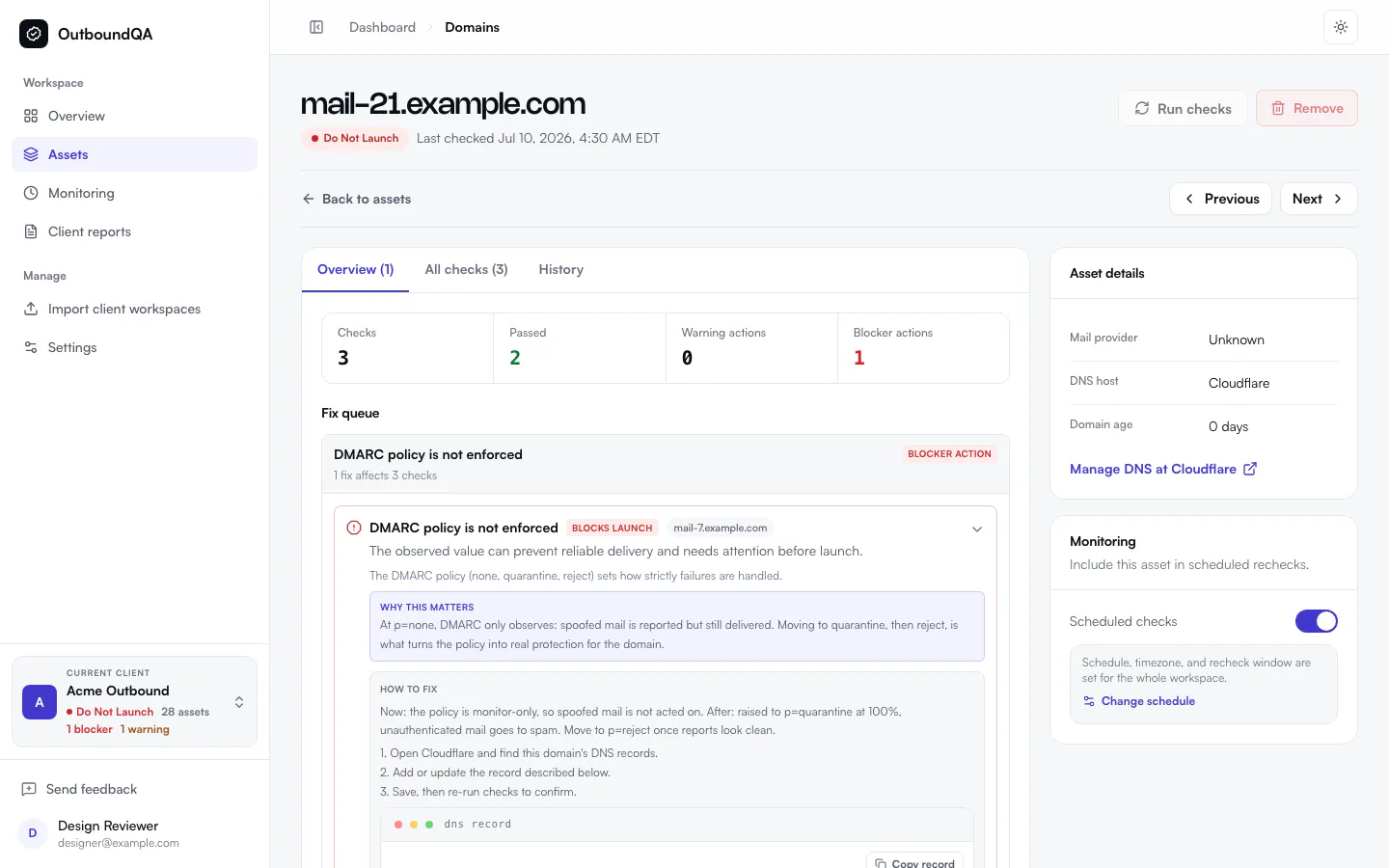
OutboundQA asset detail showing a grouped remediation action with evidence and the exact DNS fix
Related check failures now lead to one clear remediation action.

The difficult part of launch QA is rarely finding one failed check. It is turning several related failures into one safe action that an operator can complete without guessing.

This update makes that path clearer across evidence, remediation, reports, and the sending infrastructure OutboundQA can inspect.

Fix the root problem once

Related failures are now grouped into one remediation action. If a missing DNS record explains several downstream failures, OutboundQA shows the primary fix first and keeps the related evidence attached to it.

Each action explains:

  • What is broken.
  • Why it changes the launch verdict.
  • Which assets are affected.
  • The exact record or configuration to change.
  • Which checks should clear after the fix.

This reduces duplicated work and makes rechecks easier to interpret.

Evidence that leads to an action

Check results now use the available evidence more directly. DNS records, provider expectations, blacklist findings, and sender requirements are presented in formats that match the problem instead of falling back to a generic evidence block.

Passing checks can also include advisory guidance when there is a useful next step that does not change the verdict.

Check the SMTP egress path

Workspaces can now include SMTP egress assets. OutboundQA checks the public identity of the sending path, including PTR and reverse DNS, forward-confirmed reverse DNS, HELO alignment, generic cloud hostnames, and the live SMTP banner when it is reachable.

These checks do not predict inbox placement. They make a previously hidden part of the launch infrastructure visible before sending starts.

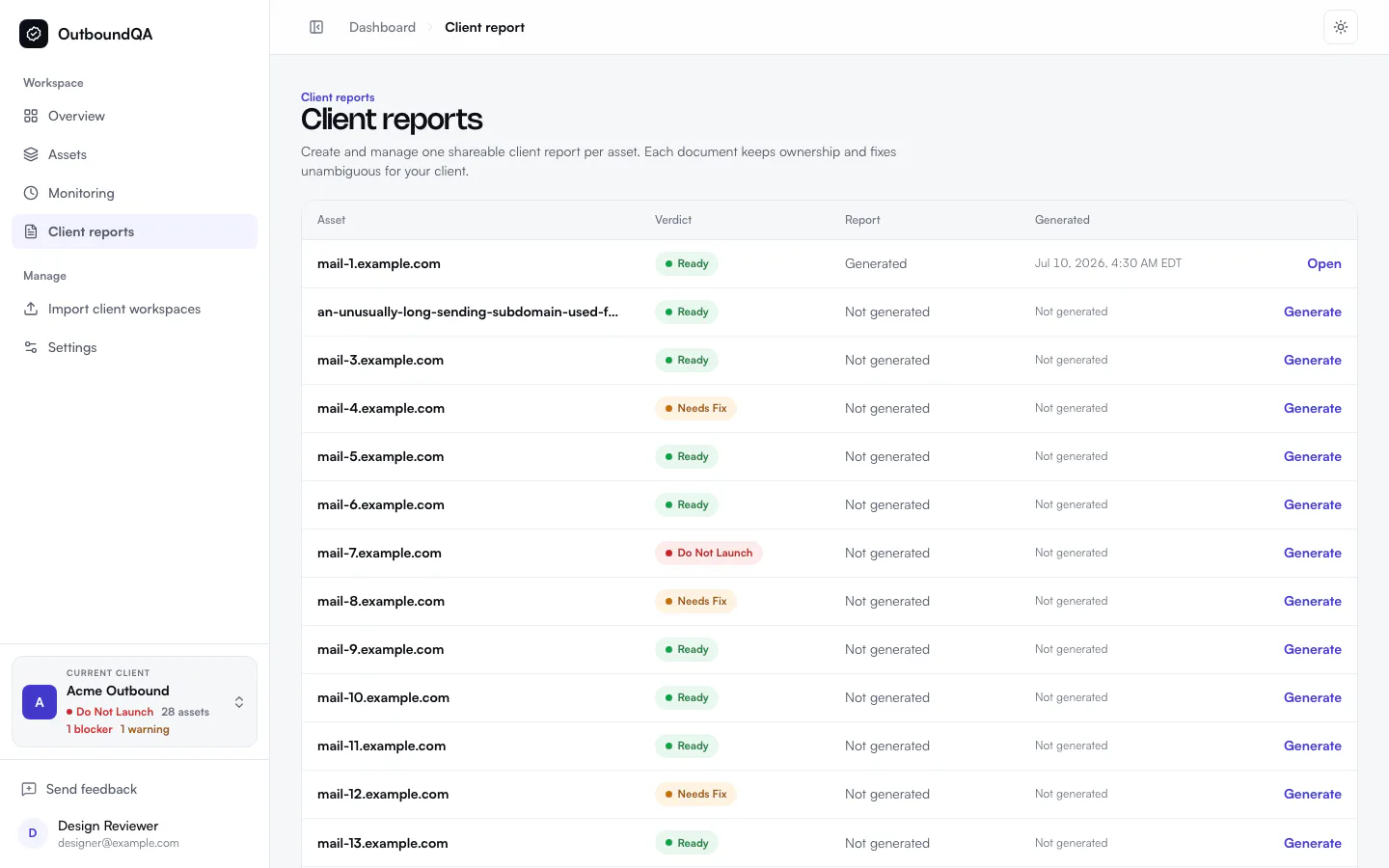
OutboundQA workspace report showing a launch verdict, issue counts, and assets included in the report
Reports stay scoped to the active workspace and summarize the evidence behind the verdict.

Reports and notifications are easier to trust

Report generation and navigation now stay scoped to the active workspace. SMTP assets appear alongside domains, inboxes, and tracking domains, and the report flow gives clearer feedback when generation is still running.

Notification settings now separate operational preferences from delivery destinations. OutboundQA also warns when alerts are enabled but no active destination can receive them.

Smaller improvements

  • Team invitations and invite acceptance are available from account settings.
  • DNS changes appear in workspace History alongside monitoring activity.
  • Workspace and plan usage are easier to see from the app sidebar.
  • Asset navigation, empty states, and feedback reporting are clearer on mobile and desktop.

Every change in this roundup has the same goal: move from a failed check to a verified fix with less interpretation in between.